

Electrical Properties Tomography

Electrical Properties (EP) have the potential to expand the biological specificity of MRI, improve its safety assessment, and increase the precision of ablation treatments. My primary contribution to EP reconstruction was the design of a problem-dedicated transceiver array that generated RF field patterns with strong EP encoding. In addition, I helped establish the potential of neural network-based EP reconstruction, by co-developing physics-informed and vision transformer-based models. Finally I co-authored three guideline papers that defined best practices for phantom construction, acquisition strategies, and standardization in EP reconstruction and a review article on clinical applications of conductivity imaging.

1
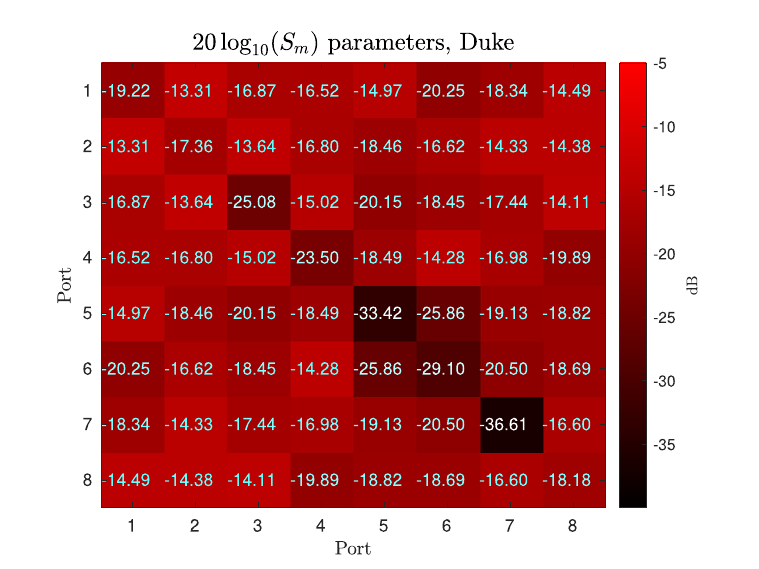
The scattering parameters of the RF coil array loaded with the "Duke" head model, after lumped-element and matching network optimization.

IEEE Transactions on Biomedical Engineering · 2021

Magnetic-resonance-based electrical property mapping using Global Maxwell Tomography with an 8-channel head coil at 7 Tesla: a simulation study

Global Maxwell Tomography (GMT) is a volumetric technique for noninvasive estimation of electrical properties (EP) from magnetic resonance measurements. This simulation study assessed GMT's performance with a realistic custom RF coil. We designed a transceive RF coil with 8 decoupled channels for 7T head imaging. We calculated the RF transmit field inside heterogeneous head models for different RF shimming approaches, and used them as input for GMT to reconstruct EP for all head voxels. We demonstrated that GMT can reliably reconstruct EP in realistic simulated scenarios using the proposed RF coil design.

Read the paper
2
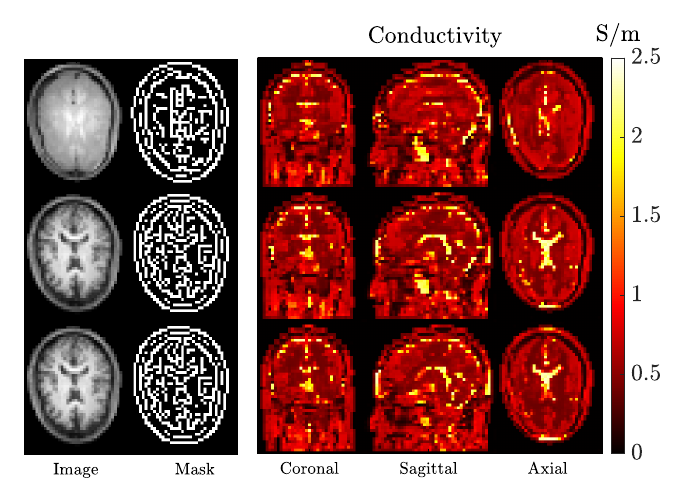
In vivo results, including MRI images, Canny edge masks, and reconstructed conductivity maps for different MRI measurements, shown for representative coronal, sagittal, and axial planes.

Magnetic Resonance in Medicine · 2025

Editor's Pick

MR electrical properties mapping using vision transformers and canny edge detectors

This work developed a 3D vision transformer-based neural network to reconstruct electrical properties (EP) from magnetic resonance measure- ments. The network used the magnitude of the transmit magnetic field of a birdcage coil, the associated transceive phase, and a Canny edge mask that identified the object boundaries as inputs to compute the EP maps. The was network was trained on a dataset of 10k synthetic tissue-mimicking phantoms and fine-tuned on a dataset of 11k realistic head models. Performance was assessed in-distribution simulated data, out-of-distribution head models, with and without synthetic lesions, experiments for an inhomogeneous phantom and a volunteer. The in vivo EP reconstruction truthfully preserved the subject's anatomy with average values over the entire head similar to the expected literature values. The new approach marked an important step towards the development of clinically-usable in vivo EP reconstruction protocols.

Read the paper
3
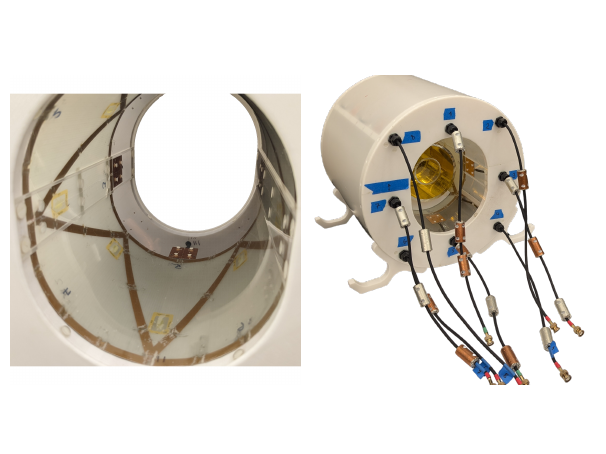
7 tesla 8-channel triangular transceiver RF coil array used for EP reconstruction with the VSIE-based GMT.

IEEE Transactions on Biomedical Engineering · 2025

Global Maxwell Tomography Using the Volume-Surface Integral Equation for Improved Estimation of Electrical Properties

Global Maxwell Tomography (GMT) is a noninvasive inverse optimization method for the estimation of electrical properties (EP) from magnetic resonance (MR) measurements. GMT uses the volume integral equation (VIE) in the forward problem and assumes that the sample has negligible effect on the coil currents. Consequently, GMT calculates the coil's incident fields with an initial EP distribution and keeps them constant for all optimization iterations. This can lead to erroneous reconstructions. This work introduces a novel version of GMT that replaces VIE with the volume-surface integral equation (VSIE), which recalculates the coil currents at every iteration based on updated EP estimates before computing the associated fields. The use of VSIE over VIE enhances GMT's performance by accounting for the effect of the EP on the coil currents.

Read the paper

Journal of Magnetic Resonance Imaging · 2025

Construction of Phantoms for MR Electrical Properties Tomography (From Structure to Composition): A Guideline From the ISMRM Electro-Magnetic Tissue Properties Study Group

MR-­based Electrical Properties (EPs) Tomography (MR-­EPT) denotes non-­invasive electrical conductivity and permittivity mapping methods using MR measurements. The lack of standardized tissue-­mimicking phantoms hinders reproducibility studies and method comparisons. For example, the NIST/ISMRM MRI system phantom has contributed significantly to standardization efforts in relaxometry, underscoring the importance of having similar benchmarks for MR-­EPT. The guidelines presented in this work outline the importance of MR-­EPT phantom design and construction, focusing on structure, composition, and reliability.

Read the paper