

MRI Image Reconstruction

I have contributed to advancing machine learning methods for accelerated MRI reconstruction, with a focus on improving image quality, robustness, and clinical reliability. I developed a novel unrolled neural network architecture that integrates cross-domain learning with transformer modules to reconstruct MRI images from undersampled k-space data. In addition, I introduced an uncertainty quantification framework for such MRI image reconstruction model. This framework computes pixel-wise confidence intervals with statistical guarantees, providing a quantitative measure of reliability for each reconstructed image–something not available in current clinical reconstruction pipelines. This work shows that uncertainty can serve as a confidence surrogate for deep-learning-based MRI reconstruction, when ground-truth reference images are unavailable. These contributions advance the broader goal of developing MRI reconstruction methods that are not only fast and highly accurate, but also trustworthy, supporting safer deployment of deep learning in clinical imaging.

1
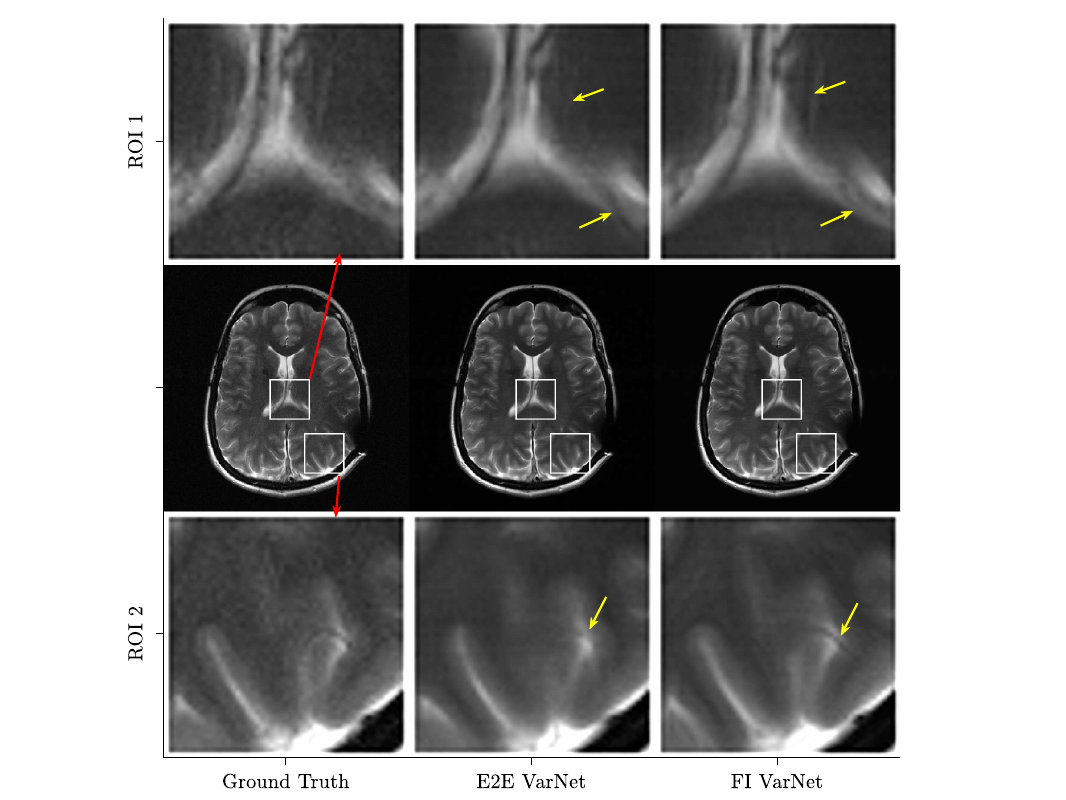
Comparison against the fully-sampled ground-truth of image reconstructions obtained using the FI VarNet and E2E VarNet models for four-fold undersampling.

Scientific Reports · 2024

Accelerated MRI Reconstructions via Variational Network and Feature Domain Learning

This work introduces three architecture modifications to enhance the performance of the end-to-end (E2E) variational network (VarNet) for undersampled MRI reconstructions. We first implemented Feature VarNet which propagates information throughout the cascades of the network in an N-channel feature-space instead of a 2-channel feature-space. Then we included a custom attention layer that utilizes the spatial locations of Cartesian undersampling artifacts to further improve performance. Lastly, we combined the Feature and E2E VarNets into the Feature-Image (FI) VarNet, to facilitate cross-domain learning and boost accuracy. FI VarNet secured second place in the public fastMRI leaderboard for 4x Cartesian undersampling, outperforming all open-source models in the leaderboard. The proposed FI VarNet enhances the reconstruction quality of undersampled MRI and could enable clinically acceptable reconstructions at higher acceleration factors than currently possible.

Read the paper
2
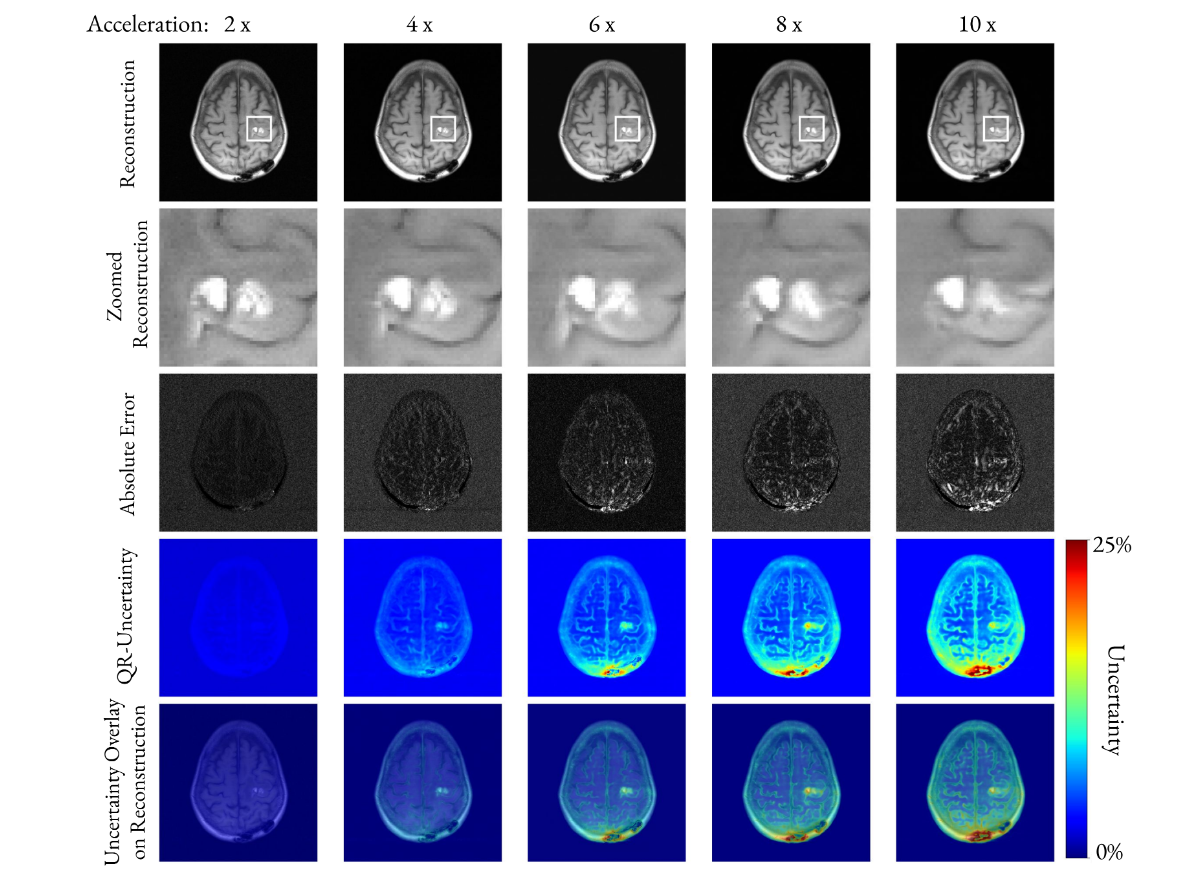
Reconstructed images, zoomed lesion views, absolute errors with the ground-truth, and corresponding QR-based uncertainty maps for one abnormal brain and five acceleration factors.

Magnetic Resonance in Medicine · 2026

Pixel-Wise Uncertainty Quantification of AcceleratedMRI Reconstruction

This work introduced an automated method to assess the quality of under-sampled MRI reconstructions. We proposed a general framework for pixel-wise uncertainty quantification in accelerated MRI reconstructions, enabling automatic identification of unreliable regions without using ground-truth fully-sampled reference images. Our method integrates conformal quantile regression with learning-based image reconstruction methods to estimate statistically rigorous pixel-wise uncertainty intervals. We trained and evaluated our model on Cartesian undersampled brain and knee dataobtained from the fastMRI dataset using acceleration factors ranging from 2 to 10. Quantitative experiments demonstrate strong agreement between predicted uncertainty maps and true reconstruction error. Qualitative examples further show the uncertainty maps based on quantile regression capture the magnitudeand spatial distribution of reconstruction errors across acceleration factors, with regions of elevated uncertainty aligning with pathologies and artifacts. The proposed framework enables evaluation of reconstruction quality without access to fully-sampled ground-truth reference images.

Read the paper